
Premiumisation opportunities in Southeast Asian agricultural commodities
Yiwen Lu - Senior Associate, Singapore
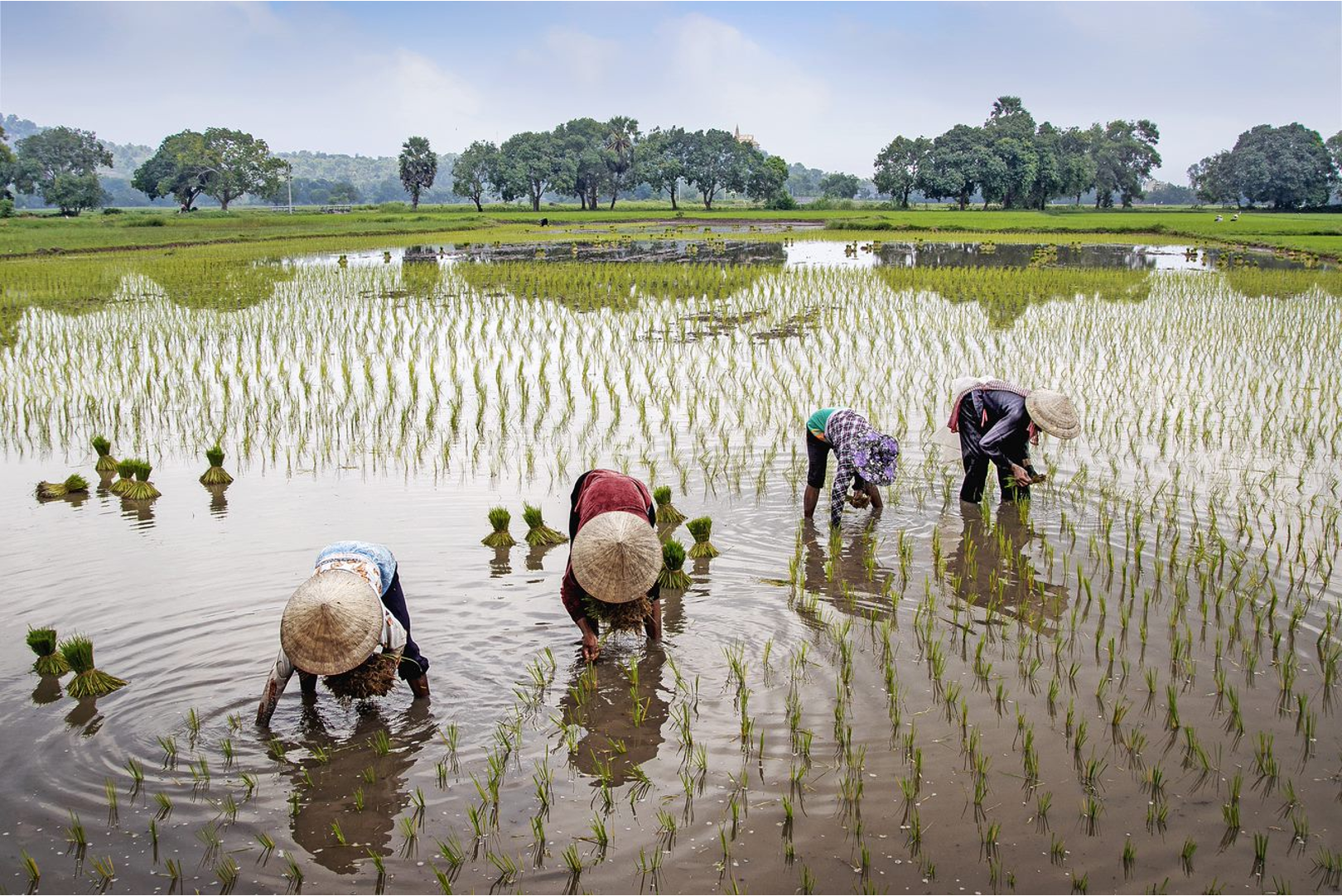
While researching The Opportunity for AgriTech Investment in Southeast and South Asia with Briter for Omnivore, our team at Beanstalk were confronted with a question: there are so many agricultural commodities from Southeast Asia that are taken for granted, such as rice, or palm oil. But which commodities from this region can actually command a premium, what is the size of the prize, and can more of this benefit remain in local economies?
We plotted a set of commodities sourced from Southeast and South Asia on two axes:
Horizontally, the percentage premium that a differentiated version of the commodity commands over its conventional benchmark.
Vertically, the total addressable market for that commodity globally.
The numbers are approximations aggregated from a number of market research reports, retailer and brand sites, news research and scientific journals. We then tagged each commodity with the countries in the region that have a production advantage in it.
This particular chart never made it into the published report, but its insights did shape a fair amount of what did - especially our thinking on sustainable consumer brands, which ended up as one of the four verticals the report identifies as showing credible momentum.
I came back to the chart recently because four businesses have been in the news since we published the report, and between them they illustrate a broader set of premiumisation opportunities in Southeast Asian agricultural commodities and offer an example of how to capture more of the benefit on-shore.
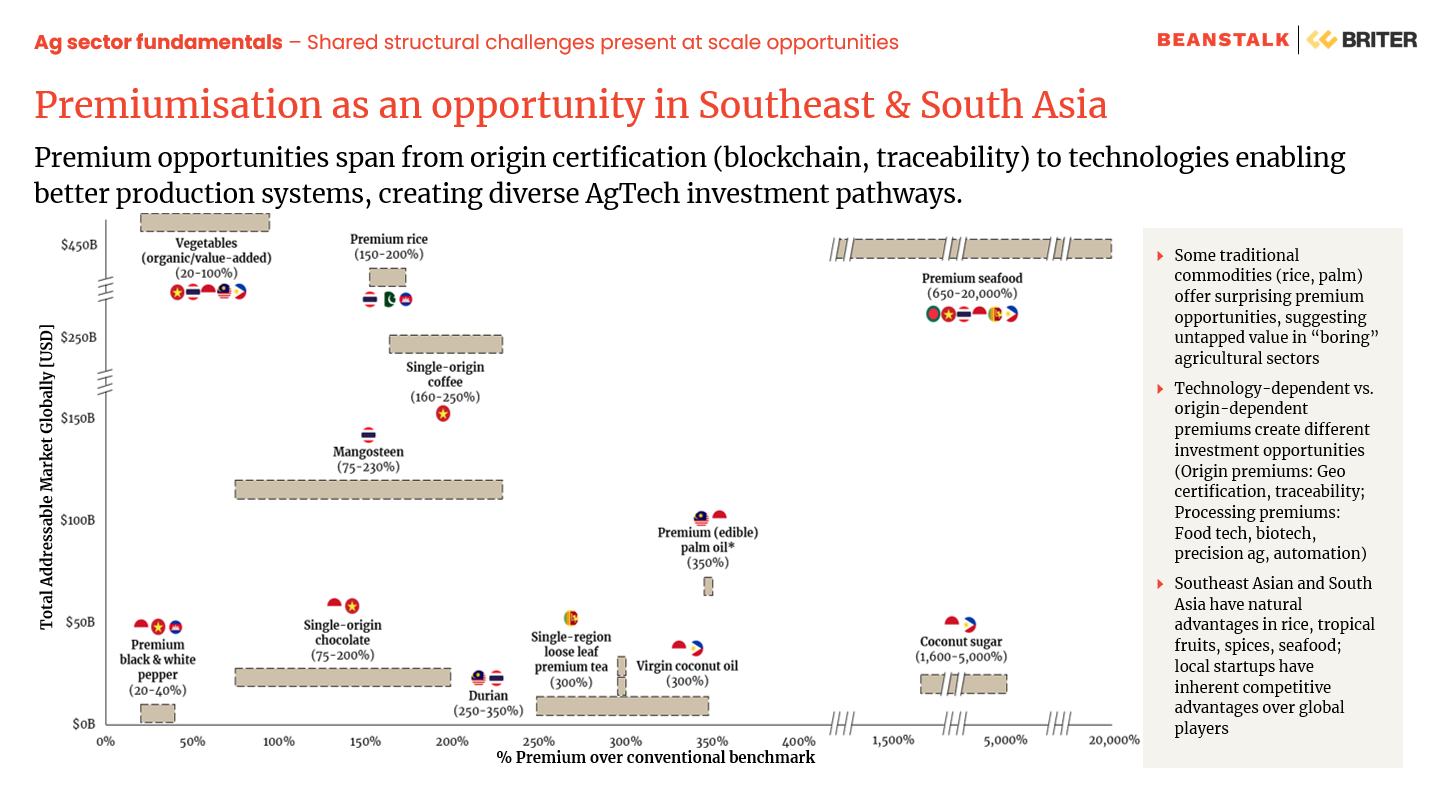
Source: Beanstalk and Briter analysis for Omnivore, May 2025.
Where the research surprised us
The first thing that surprised us was some of the commodities that were identified. Rice is a traditional and ubiquitous commodity grown at scale across the region and trade globally. Our analysis put the premium band for rice at roughly 150 to 200 percent over the conventional benchmark, sitting against one of the largest addressable markets on the chart. Coconut sugar showed premium multiples in the thousands of percent, though against a far smaller market. Premium black and white pepper showed one of the narrowest premium bands we mapped, at 20 to 40 percent.
Our second observation concerned where the premiums come from. Some of these premiums are origin-dependent - differentiated through geography, geographical indication status, or traceability back to a specific place. Others are technology-dependent, attributable to improved farming practices or differentiated post-farm processing capability.
Below I have shared four clear examples of these different types of premiums, which is helpful reading for anyone deploying capital into the space or working with an agricultural commodity.
Four businesses and four different entry points
Rize: earning the premium at the farm
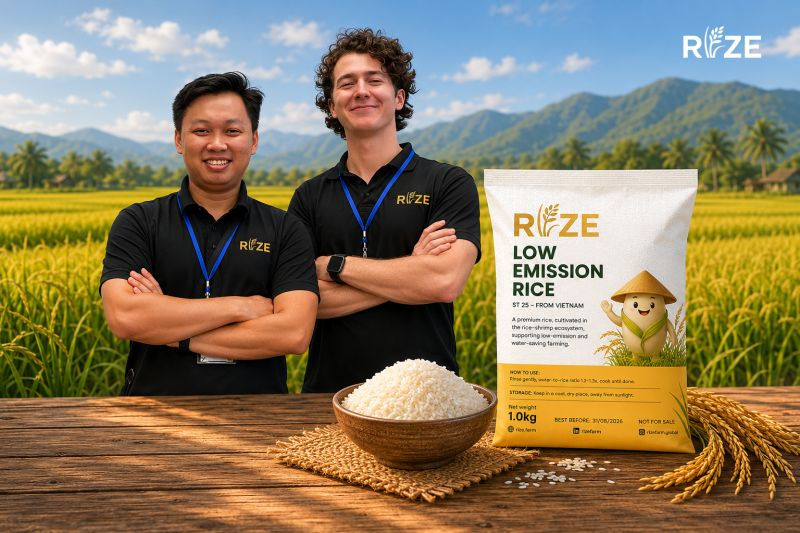
Rize is a Singapore-based agritech working with around 17,000 smallholder rice farmers across more than 50,000 hectares in Vietnam and Indonesia. The company promotes Alternate Wetting and Drying (AWD), an irrigation method endorsed by the International Rice Research Institute (IRRI), which cuts methane emissions from rice cultivation by up to half and water use by 20 to 30 percent without reducing yield. Layered on top of this approach is farm-to-buyer traceability and progress toward carbon certification.
In July 2026, Rize closed a Series B, led by BNP Paribas Asset Management Alts with The Rockefeller Foundation, Temasek and Breakthrough Energy Ventures, as well as USD 11 million in debt from UOB, BIDV and Temasek Foundation. The company has already shipped 1,500 tonnes of low-emission rice to buyers in Europe, Canada, Australia and Singapore.
I’d call Rize a vertically integrated value chain player because it works across the entire farm-to-sales process. Instead of selling better-tasting rice, Rize is an AgTech company selling a verified production method, and the verification is the product. Given its extensive local footprint in Southeast Asia, the company is able to work directly with farmers and introduce better farming practices, despite how capital-intensive that work is (hence the debt financing). This is an upstream play in premiumisation: field operations and MRV systems are always capital-intensive; in rice, luckily, there is an emerging set of buyers willing to pay a premium for environmental credentials.
On rice as a commodity: rice is a ubiquitous commodity, both at its origin in Asia and across the world. While there are premium rice varieties on the market, such as Thai Hom Mali rice or Japan’s Kinmenai rice, the grocery aisles are crowded and many consumers are price conscious. Upstream innovations that transform farming methods, improve traceability and compliance, and then capture a premium in doing so, are more investable for the foreseeable future.
Copra Coconuts: earning the premium through a moat in processing, branding, and geographic arbitrage
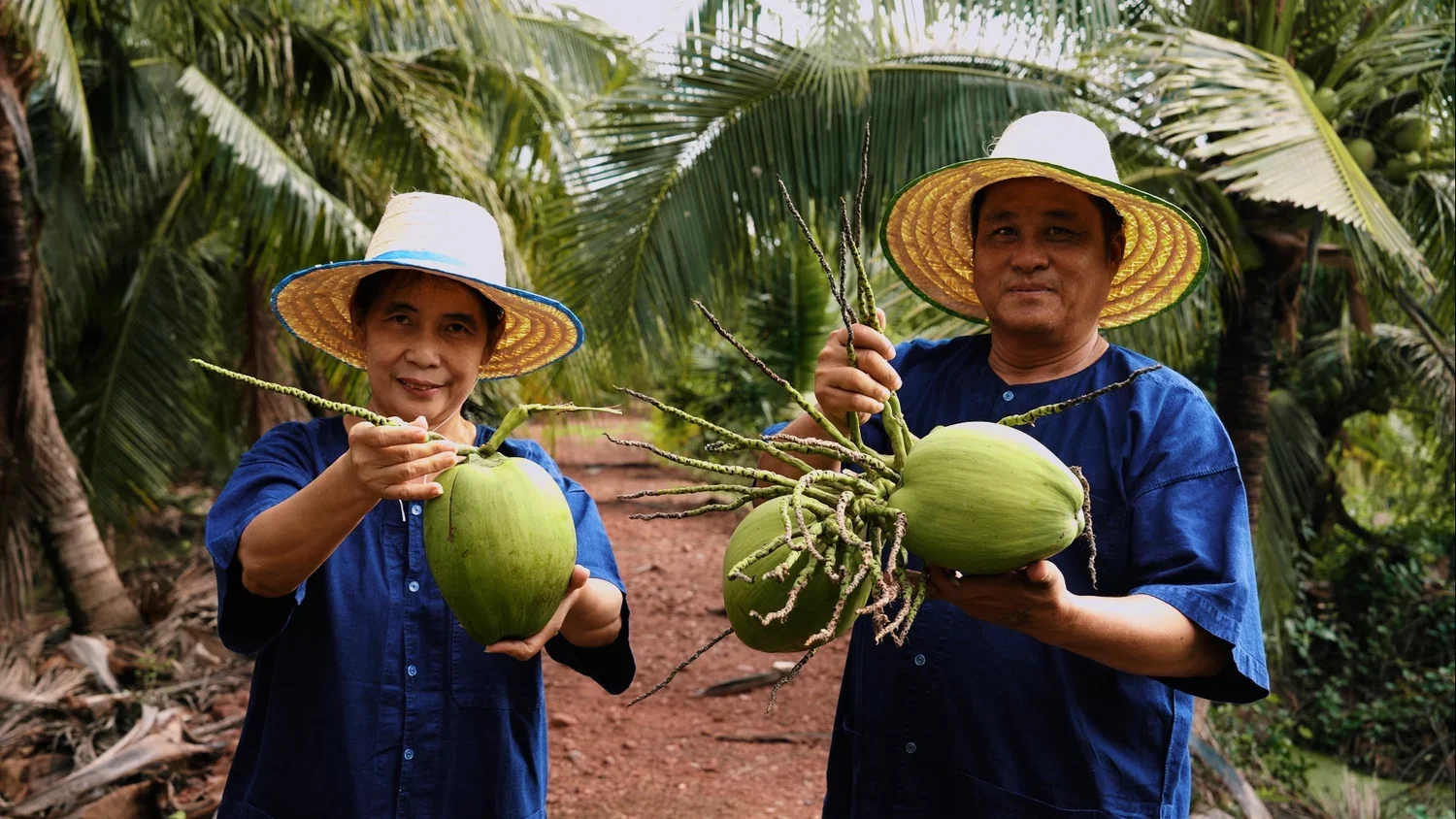
Copra Coconuts is a New York-headquartered producer of super-premium Thai Nam Hom coconut water, running a cold-chain, extract-and-fill-on-site operation at its facility in Thailand. Nam Hom is an aromatic Thai coconut variety, and Copra’s coconut water products are sold chilled, with a sweet flavour and a faintly pink colour visible through their semi-transparent packaging.
Vita Coco acquired the business on 22 July 2026 for USD 175 million upfront. Copra expects full-year 2026 net sales above USD 100 million and has delivered a 48 percent net sales CAGR over the past three years, with sales predominantly in North America.
The success of Copra Coconuts shows that even saturated categories aren’t impenetrable. Yes, there’s a real origin asset in Nam Hom, and Vita Coco has been explicit that it’s buying a leading branded position in the super-premium segment. But what really makes the asset hard to replicate is the unglamorous engine behind the brand: deep sourcing relationships and the on-site, extract-and-fill cold-chain processing that enables a fresh, chilled product to travel. The human-centred storytelling and branding sit on top of that operational moat, and together they’re what allow Copra to capture the premium midstream, between the farm and the bottle.
On coconut as a commodity: coconut is a commodity, but its by-products - water, oil, sugar - don’t have to be. Premium positioning is crucial for any downstream operator to capture value. And, of course, there is always the opportunity for geographic arbitrage: take the same Copra bottle and place it on a supermarket shelf in Southeast Asia, and it will not fly off the shelf. But in the US, it can become a premium lifestyle purchase if you tell the right story. The difference lies in consumer perception, cultural context, and scarcity.
Pepper Field: great-tasting cultivar and geographic arbitrage
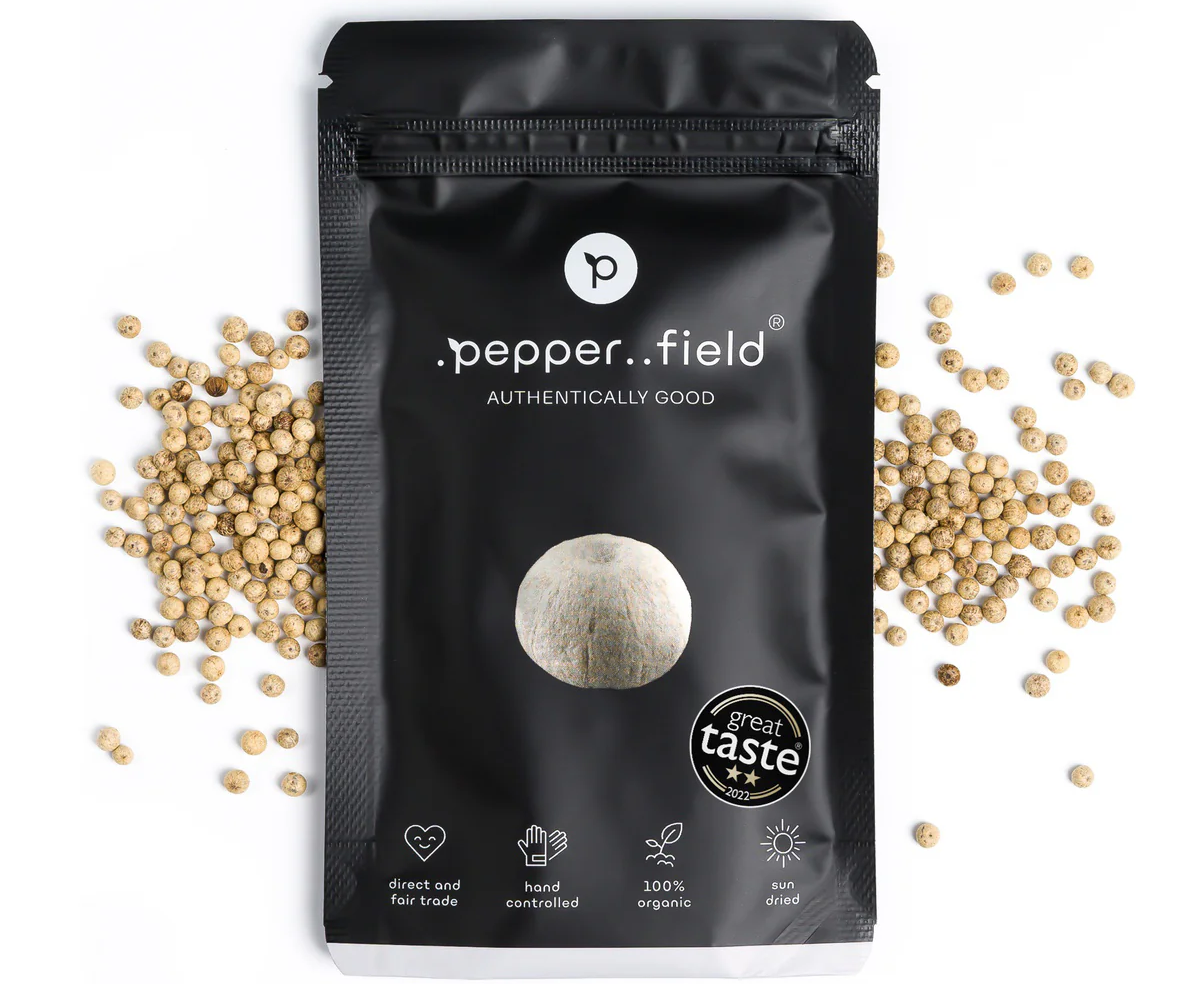
Pepper Field is a brand in the Czech Republic that has built a business on Cambodian Kampot pepper, which carries EU geographical indication protection. Working through its Cambodian subsidiary, the company buys directly from smallholder farming families at fixed fair-trade prices of USD 15 per kilogram for black pepper, USD 25 for red and USD 28 for white. Since launching in 2018, it has grown into what Forbes has described as the largest exporter of Kampot pepper in the world (accounting for roughly 40 out of 110 tons exported annually from Cambodia), and it has invested in freeze-drying and vacuum-packing technology to preserve the pepper's aroma on the journey to Europe.
This is arguably a similar example to Copra Coconuts. Southeast Asian consumers are generally familiar with premium black pepper across the region. - Certain areas in Malaysia, Vietnam and Cambodia are all known for producing it. However, Asian consumers don't use pepper the same way European consumers do. In some European cuisines, spices appear sparingly and salt and pepper are heavily used to flavour a dish. Pepper Field has therefore seized a tremendous geographic arbitrage opportunity by importing a premium black pepper cultivar directly from its origin. It became the largest individual exporter of Kampot pepper in the world simply because of the scale of European demand relative to the small number of premium pepper suppliers able to build a brand around their products.
Marou Chocolate: earning the premium at the shelf
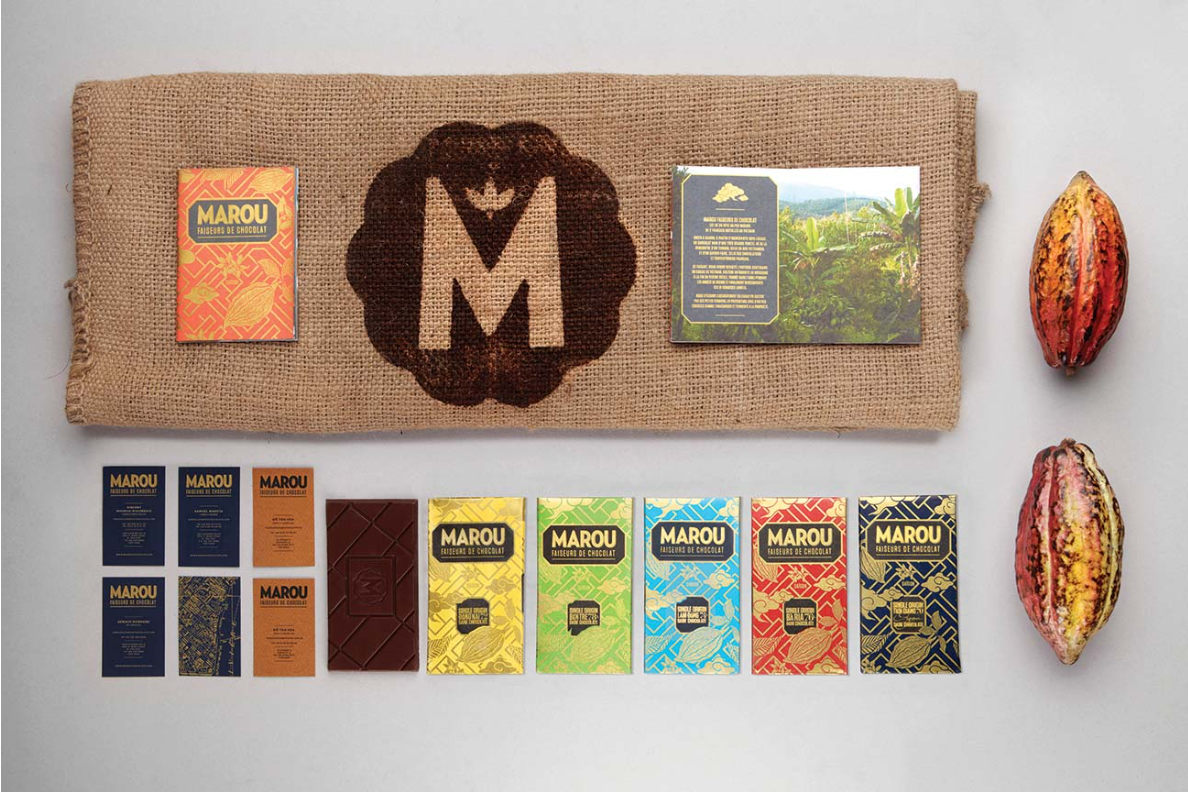
Marou was founded in Ho Chi Minh City in 2011 by Vietnam-based French entrepreneurs Samuel Maruta and Vincent Mourou, becaming Vietnam's first home-grown bean-to-bar chocolate maker. The business sources cacao from six southern provinces, works with over 500 farmers, and makes single-origin bars in which each province’s beans carry a distinct flavour profile. Mekong Capital invested through Mekong Enterprise Fund IV in 2021. The company now runs more than 20 stores across Vietnam alongside exports to Singapore, Europe, the UK and the US, and recently opened its first physical retail location outside Vietnam in Singapore.
There are countless bean-to-bar brands originating from Southeast Asia, but Marou Chocolate has really become a standout in the crowded marketplace through its unique storytelling, design and retail experience. The packaging builds the brand's narrative and identity: hand-drawn illustrations of cacao pods, flowers, and monsoon clouds are layered over a traditional ceremonial lattice pattern, silk-screen printed in antique gold ink by local print shops. Each cacao-growing province - Tien Giang, Ben Tre, Dak Lak - gets its own colour palette, set in a modernist typeface drawn from Vietnam’s classic street signage. Some bars go a step further on sustainability: rather than foil or film, they’re wrapped in plastic-free paper made from upcycled cacao husks. Marou's Ho Chi Minh City flagship store extends this narrative, turning the packaging craft and origin storytelling into a unique retail experience.
Marou is also an excellent example of keeping the premium at source. With the business permanently operating out of Vietnam, they have committed to sustainable and ethical production. Marou works directly with farmers and pays them prices that are significantly higher than the standard international commodity market, operates transparently with farmers and suppliers, requires its cacao to be produced in agroforestry systems and provides organic and regenerative farming education and upskilling for farmers at six province level demonstration farms.
Different pathways, different capital
When set side by side, these four examples illustrate that a premium in Southeast Asian agriculture can be captured almost anywhere along the value chain:
At the farm - through practice and verification;
In processing - through capability that is hard to replicate;
At the shelf - through branding and certification.
For investors these offer different propositions: upstream means field operations, long payback periods, and a bet on buyers who will pay for a credential, midstream means capex and logistics, while downstream means marketing spend and channel economics. However beyond simply deploying capital, there is an opportunity for meaningful capital to also achieve impact.
In three of the four cases discussed here, the majority of the premium is captured outside the country that grows the commodity. Although the farmers producing for Rize and Pepper Field benefit from improved income, stability and livelihoods, the question arises of whether more of the premium in agriculture can be captured and kept locally. Marou Chocolate is an excellent example of bringing localised benefit and genuine value creation.
At Beanstalk, we believe the opportunity ahead is for local entrepreneurs across Southeast Asia to capture that same kind of value at source. To achieve that, processing capability and traceability systems to prove and keep a premium locally will be required, as well as support and financing for innovators and entrepreneurs to help get their businesses off the ground. Investors, operators and governments who can help build that infrastructure and support these opportunities will allow more of agriculture's premium to stay in the hands of the people who grow it.