
Near & mid-term opportunities for agrifood innovation in Southeast Asia

A farmer waters his crop in Vietnam
Beanstalk Senior Advisor, Eng Keat Lee
Agriculture makes up about 10 percent of Southeast Asia’s GDP and employs roughly 25% of the region’s workforce. Yet, as shown in the figure below, for several key regional crops, production yields remain 2 to 6 times lower than those of top global producers. This yield gap is more than a development statistic, it represents commercial opportunities for innovative startups capable of driving productivity improvements and value capture across these agriculture supply chains.
This article builds on insights from Beanstalk’s recent co-authored report for Omnivore, The Opportunity for AgriTech Investment in Southeast and South Asia to highlight some near and mid-term opportunities for agrifood innovation in Southeast Asia. It sets out three technology verticals already converting yield and margin pressure into paying customers: digital traceability platforms responding to export compliance rules, fintech models unlocking credit for underbanked smallholders, and aquaculture solutions tackling disease and feed cost volatility. It then works through how to navigate a fragmented market, and what separates ventures that reach product-market fit from those that stall at the pilot stage.
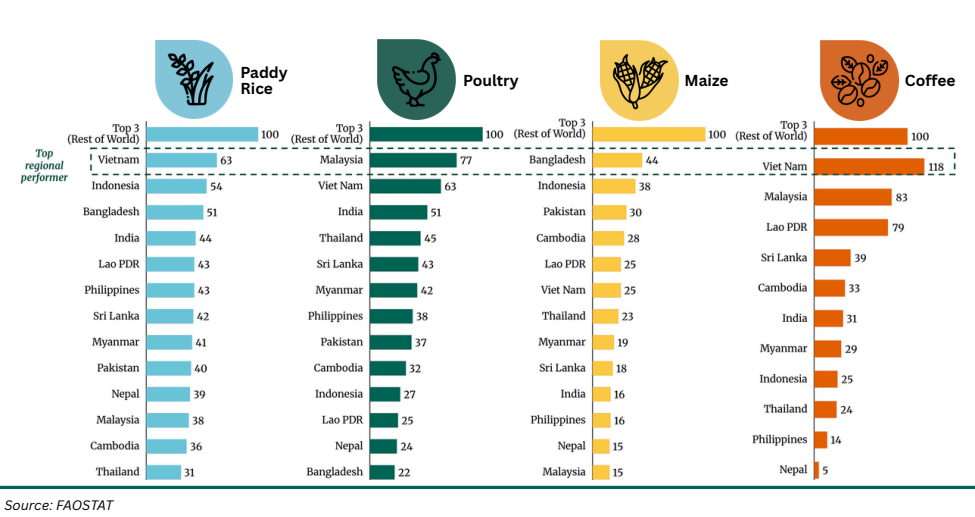
Crop Productivity across various countries in Southeast Asia and South Asia, from The Opportunity for AgriTech Investment in Southeast and South Asia
1. High-Potential Tech Verticals
From a technology solution perspective, three broad categories present the most compelling commercial opportunities in the near to mid-term:
Agri digital value chains
Agricultural producers across Southeast Asia face growing compliance and regulatory pressures on export-oriented value chains. Large multinational buyers increasingly demand full traceability. For example, the EU Deforestation Regulation (EUDR) mandates that suppliers provide precise geolocation coordinates for the land plots where commodities are produced. Digital platforms—such as Koltiva—enable supply chains to capture plot-level geolocation data, deliver end-to-end traceability, and generate compliance reports for deforestation-free sourcing. As these platform players facilitate traceability and trade, they build a strong foundation to expand into adjacent financial and operational services.
Agri fintech
Many smallholder farmers remain excluded from formal credit channels due to underdeveloped banking infrastructure and a lack of documented credit history. Without verifiable risk profiles, smallholders are often forced to rely on informal lenders charging exorbitant interest rates—averaging 25% or higher. Agtech companies that digitize farm transactions can leverage proprietary cash-flow and yield data to provide institutional and impact lenders with validated risk profiles. By embedding credit directly into input supply purchasing (e.g., buying fertilizer via a mobile platform) or off-take factoring, startups de-risk lending, drive down borrowing costs, and establish highly sticky customer relationships.
Aquaculture
Among animal protein sectors, aquaculture generates relatively high operating margins. With wild catch yields plateauing, global and regional demand for farmed aquaculture continues to rise. Several Southeast Asian nations are already among the top aquaculture producers globally. However, the sector faces two dominant operational bottlenecks: disease management and volatile feed costs. Companies providing targeted solutions to these challenges are seeing strong market traction. A key example is SyAqua, which provides Specific Pathogen-Free (SPF) shrimp parent lines engineered for superior disease resistance and faster growth cycles.
2. Tackling Southeast Asia’s Diversity & Market Entry
While these opportunities are vast, capturing them requires navigating a highly fragmented market. Each country across Southeast Asia presents distinct business practices, crop concentrations, regulatory frameworks, and market structures. Evaluating where to launch first can be daunting.
To simplify market entry, startups can segment Southeast Asia into three distinct agricultural profiles:
The Scale Commodity Markets (Indonesia, Vietnam, Thailand): Defined by large-scale production, dense smallholder populations, and mature, export-driven value chains.
The Innovation Hub (Singapore): Serves as a high-tech regional anchor, offering advanced R&D infrastructure, test-bedding support, and institutional capital.
The Frontier Markets (Cambodia, Laos, Timor-Leste): Early-stage operating environments where foundational physical and digital infrastructure investments will shape long-term agricultural growth.
The chart below indicates Southeast Asia countries’ production volume of various key crops relative to the rest of the world. It would suggest which countries to focus on if the innovation focuses on a particular crop.
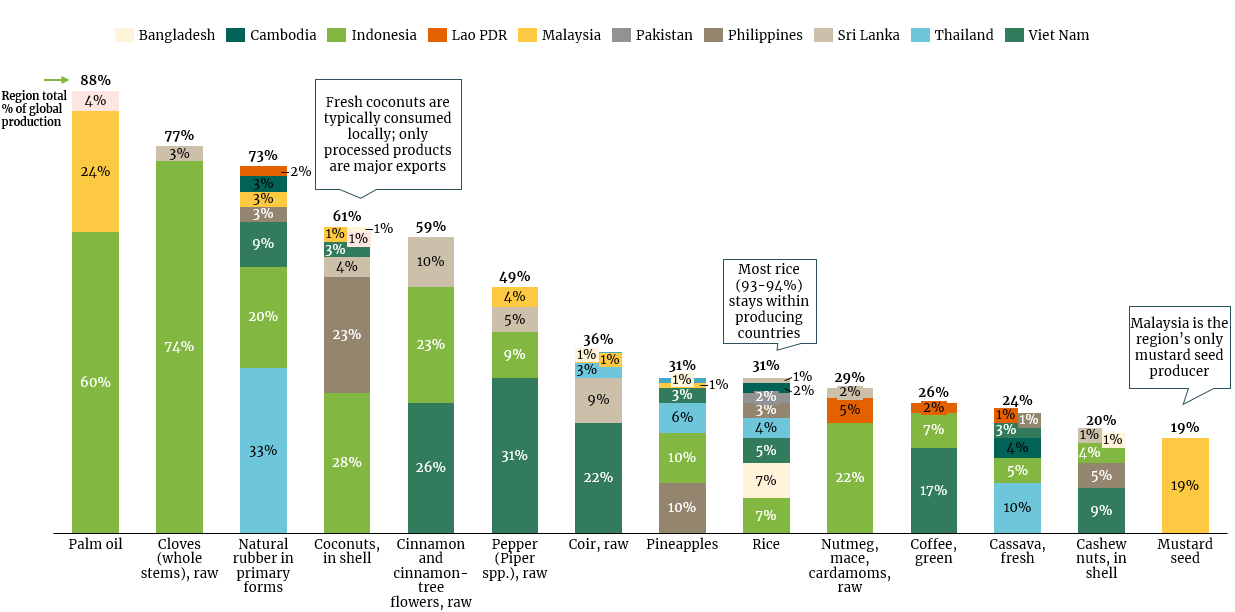
Southeast Asia and South Asian countries’ proportion of global production volume across major crops, from The Opportunity for AgriTech Investment in Southeast and South Asia
Once you identify which profile or country aligns with your technology, you can narrow down your entry point using a structured approach:
1. Focus on Crop & Value Chain Alignment: Identify where your solution directly solves a critical pain point in which part of the value chain.
2. Evaluate Customer Margins & OpEx Pain Points: Prioritize markets where prospective customers operate with higher margins or face major operational costs. (Example: Deploying pathogen-free shrimp parent lines in Vietnam's high-value aquaculture sector.)
3. Leverage Favourable Regulations: Target countries where regulatory frameworks actively encourage adoption or mandate compliance. (Example: Markets offering explicit compliance support programs for EUDR.)
4. Capitalize on Team & Network Ties: Look for markets where your leadership or technical team possesses native language skills, cultural context, or academic ties. (Example: A Japanese animal health company leveraged its Thai PhD team members to build local research partnerships and secure pilot agreements with a major Thai feed corporate.)
5. Extend Existing Client & Partner Networks: If your current corporate clients or channel partners have an operational footprint in Southeast Asia, leveraging those established relationships offers a low-friction entry route.
3. Achieving Product-Market Fit and Commercial Viability
Achieving meaningful market adoption
A common trap for founders is assuming that superior technology automatically translates into market demand. In agriculture, product-market fit is defined by commercial realities rather than technical sophistication alone. Winning startups excel in two critical areas:
Deep Stakeholder Alignment Across the Value Chain
Successful ventures invest heavily in understanding local buying behaviours, distribution channels, and ecosystem incentives. For instance, a novel bio stimulant may offer proven yield benefits, but if local retailers earn higher margins selling traditional fertilizers, the new product will struggle to gain shelf space. Because smallholder farmers rely heavily on local input dealers for advice, overcoming incentive misalignments requires intentional commercial structuring.
Aligned Revenue & Risk-Sharing Models
Smallholder farmers operate under tight margins and are inherently risk-averse; they cannot absorb the risk of unproven capital expenditure. High upfront equipment fees are major adoption barriers. Successful startups often employ rental, leasing, or performance-linked models:
An aquaculture tech provider initially structured pricing around shared feed cost savings, transitioning to a fixed subscription model only after proving economic returns.
Another agtech platform keeps its core tools free for smallholders while monetising through agribusiness input providers (e.g., seed and fertilizer companies). By delivering near real-time farm performance data to these commercial partners, the platform enables them to assess creditworthiness, track yield progress, and mitigate default risks without burdening the farmer.
4. Scaling Beyond Initial Pilots
Moving from successful pilots to regional scale is rarely a matter of simple copy-and-paste. Farmer behavior, education levels, and agronomic conditions vary significantly across provinces. Building direct, field-level sales and technical teams across vast geographies is financially unsustainable.
To achieve scale, startups must build strategic distribution partnerships with local co-operatives, agribusinesses, or government networks. However, founders must navigate distributor relationships carefully:
Fulfilment vs. Adoption: Most local distributors handle hundreds of SKUs and are optimised for logistics and fulfilment rather than customer education or technology adoption.
Driving Behavioural Change: If your solution requires behavioral shifts, agronomic training, or new digital workflows, traditional distributors rarely have the incentives or capacity to drive adoption across fragmented smallholders.
Owning Customer Discovery: Startups cannot outsource customer discovery or product adaptation. Founders must maintain lean on-the-ground teams to run localized validation trials, capture direct feedback, and actively pull product demand through the value chain.

Aquaculture shrimp farm in Vietnam
Conclusion: Bridging Innovation and Commercial Reality
The commercial opportunity for agrifood innovation in Southeast Asia is undeniable, but technology alone will not close the region's yield and income gaps. True scale is achieved at the intersection of localised product-market fit, aligned value chain incentives, and capital-efficient go-to-market strategies. For founders building in this space, and the investors and corporates backing them, the lesson is straightforward: pick a vertical and an entry point deliberately, then build for adoption from day one. Founders who view commercialisation not as a secondary step, but as a core design discipline equal to their underlying technology, will be the ones who transform Southeast Asia's agricultural landscape over the next decade