
AI in agribusiness: the cherry on top, but not a silver bullet
There is a lot of chat flying around about AI at the moment and admittedly, we're pretty bullish about its potential. The transformational potential it brings is, in our mind, an extension of what the leading agribusinesses are doing already.
It’s tempting to think of AI as a magic bullet, and it certainly can deliver some quick wins. But from our experience, AI tools are delivering the most benefit to the agribusinesses that have already built the right foundation for it to land on.
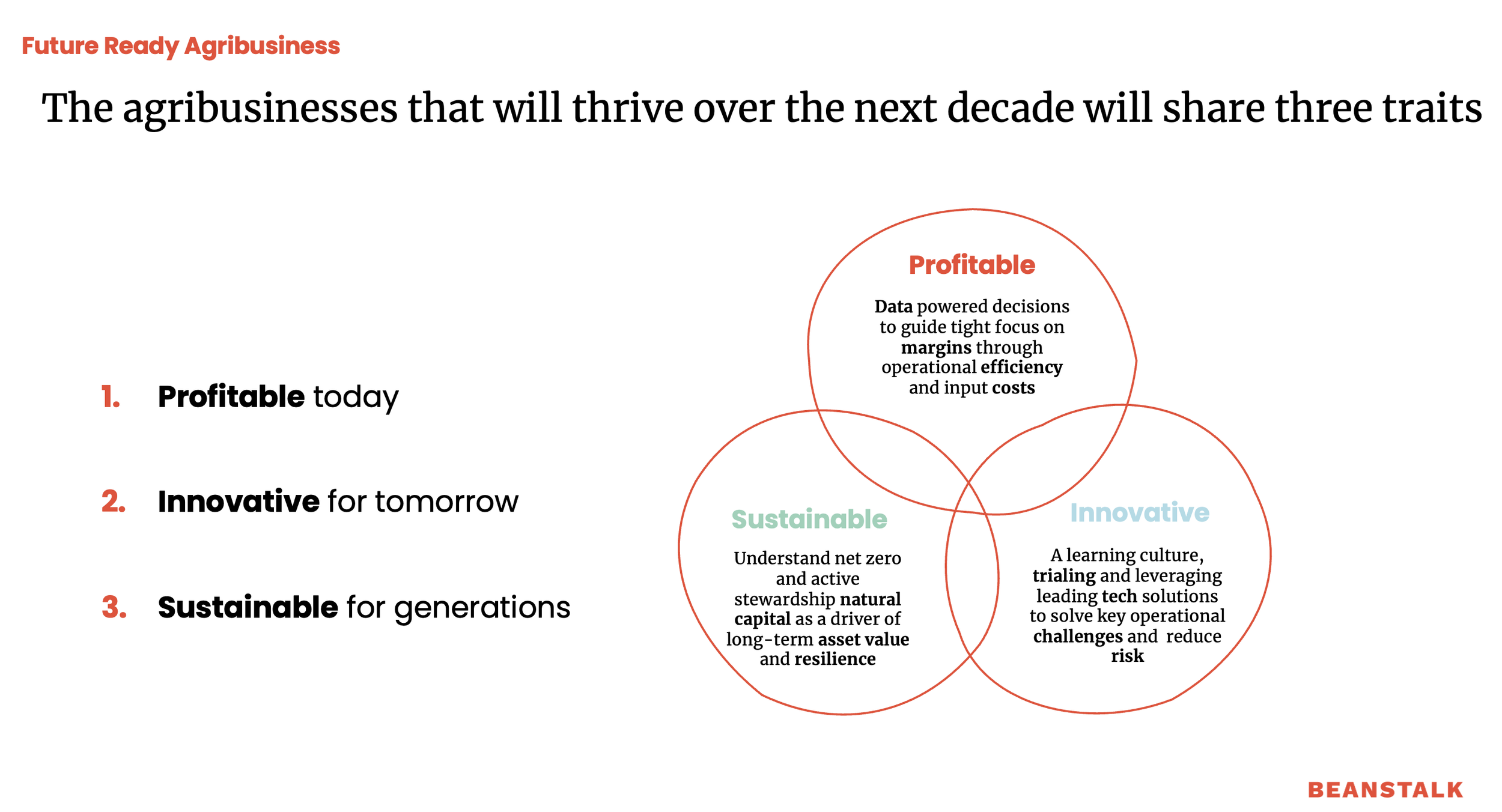
After nearly a decade of Beanstalk developing and powering the innovation function within agribusinesses across Australia and Asia, we have distilled our learnings about what that foundation looks like into a very simple framework. We believe the agribusinesses that thrive over the next decade will share three core traits that come together in a powerful multiplier. These agribusinesses are profitable, innovative, and sustainable. We have many more thoughts on these three traits, but we’re saving them for a future blog post.
If we think about mastery of those three traits as the destination, the six pillars below are the map - the core capabilities an aspiring future-ready agribusiness has to continually to build upon in order to get there. Every standout business we've come across that is genuinely pulling ahead of their category, scores well across all six, working together. We think about these pillars more as a ladder, with each pillar building the conditions for the one above it.
1. Culture & Capability
This is the base, and the one everything else depends on. How progressed is the culture, skills, and capacity to support innovation and change? A business where people are curious, willing to experiment, and trusted to raise their hand when something isn't working will out-adapt a business with better tools and a fearful team every time. Culture is sacred and slow moving, but is critical for any sustained high performance, adaptability and innovation.
2. Strategy & Processes
Culture without clear strategic direction burns energy without producing outcomes. And critically, translating that strategy into disciplined and efficient action can only be delivered through clear systems and processes. How clear is the company strategy, across the entire business, and within each team? And how well defined and utilised are the business processes to deliver on the strategy?
3. ESG
What ESG practices and reporting processes are in place, and how mature are they? This gives an agribusiness long-term license to operate. The businesses thinking seriously here aren't doing it for a slide in the annual report, they're protecting market access, capital access, and the trust of the communities they operate in. It also connects with and ignites a deeper ‘why’ in its people, who care about doing work they are proud of and leaving the planet and communities in a better state then they left it.
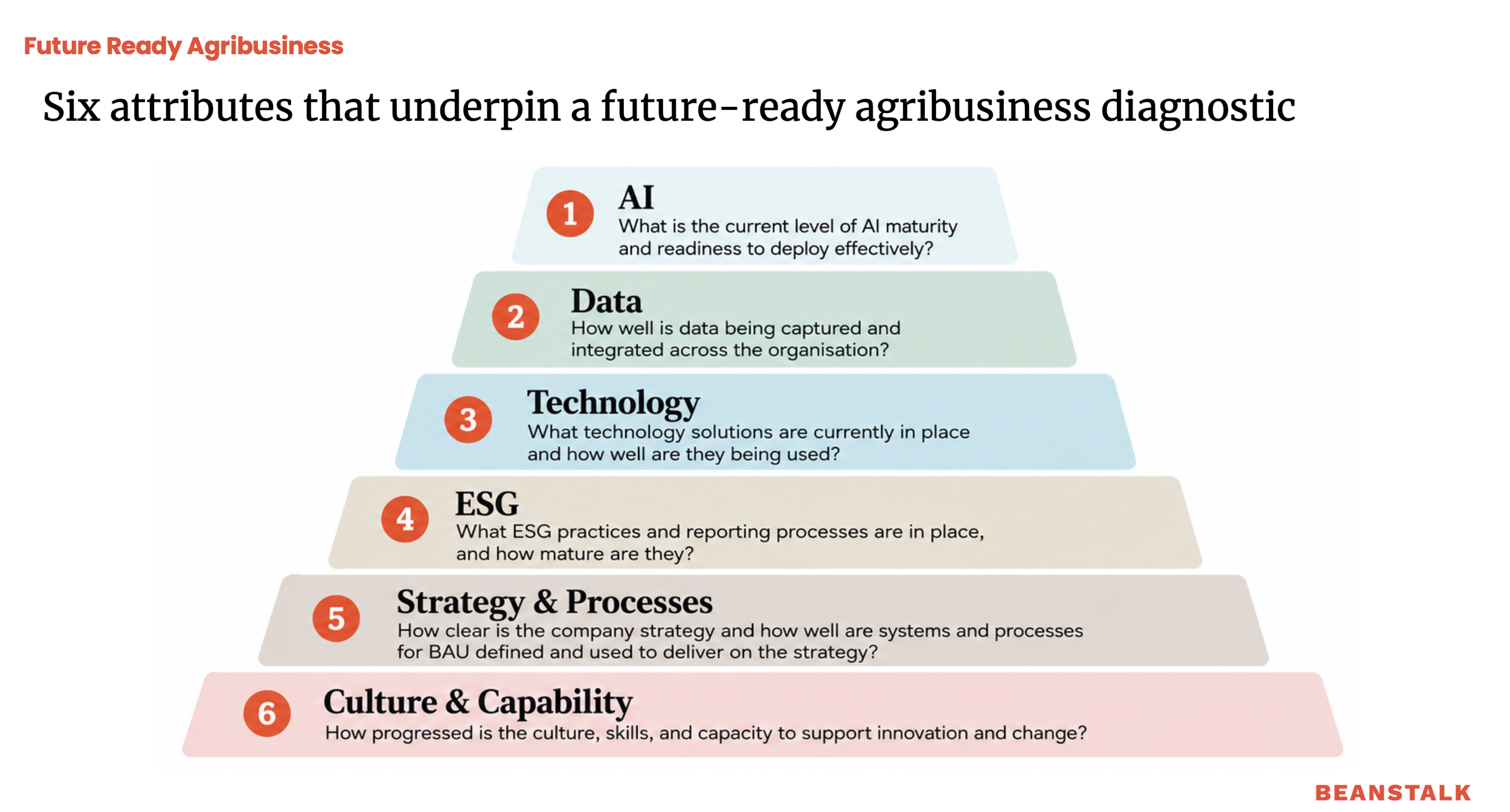
4. Technology
How well is the business leveraging an integrated technology stack to drive efficiency through the operation? And how well do they recognise the speed of change in the technology landscape? How do they meet that change with a dynamic, always-on process for identifying challenges within their business and scouting, trailing, and adopting positive ROI solutions in a consistent fashion? Only once the first three pillars are in place does technology actually compound. The right tools, deployed into a business with a clear strategy and a culture that will actually use them, multiply everything below.
5. Data
How well is data being captured and integrated across the organisation? There is no shortage of data in agriculture but the best businesses we have worked with recognise how to capture and structure their data so they can drive decision-making based on facts rather than anecdotes. This is the pillar most agribusinesses underestimate: the unglamorous work of getting information out of 5-10 unconnected systems and into a form that can actually inform decisions is an arduous task when beginning on that journey.
6. AI
And then, at the top of the ladder, AI. What is the businesses current level of AI maturity and readiness across the team to deploy it effectively? In Horizon 1: Getting the foundational pieces in place, such as model selection, governance, team training, and strategic direction from leadership. In Horizon 2: building new tools to speed up current work flow and Horizon 3: completely reimagining your business model, industry value and organisation structure.
We are genuinely enthusiastic about what AI means for agribusiness. Faster decisions, less time lost to manual reporting, sharper visibility into the business than most boards have ever had. We think it's one of the biggest opportunities agribusiness has seen in a generation.
But, AI is not a silver bullet, and it's not necessarily where you start.
To be clear I'm not saying you need to have all of the first 5 pillars at 10 out of 10 before you even think about AI. In fact quite the opposite. There is a huge amount of low-hanging fruit to drive operational efficiency, particularly for head office workplaces. But to truly unlock the power of these new AI tools, it must be part of a broader set of organisational capabilities.
Deploy AI into a business without the first five pillars in place and you get what you'd expect from putting a fuel in a car with no wheels. The operations we are seeing getting real value from AI right now aren't the ones with are right our on bleeding edge of what is possible with agentic AI workflows, they're the ones who have either already done the foundational work first: clear culture, clear strategy, a genuine ESG position, solid technology foundations, and data they can actually trust. For these operations AI slots in very neatly, not as an accelerator to what they are already doing, not a tool to paper over the gaps.
It's also why we don't necessarily start client conversations by talking about an AI solution. We start by assessing a business across all six dimensions. Not to find the squeakiest wheel but the highest-value unlocks across the one of the 6 pillars, that if strengthened, does the most to lift the other five. Sometimes that's AI, sometimes it’s not.
If you're a board or leadership team asking "what do we do about AI," the right first question might not be about AI at all. Perhaps it's asking how ready your business is, across all six pillars together, to actually capture the value AI can unlock?