
Our food system needs AI, and it couldn't come at a better time
Cal Archibald, Director
We are asking agriculture to do something it has never done. Feed a population heading toward 10 billion. Close a projected food gap of more than 50% by 2050. Do it profitably for farmers. Provide livelihoods for billions around the world. And do it while shrinking agriculture's environmental footprint, rather than expanding it.
These requirements have always pulled against each other.
More food has meant more land, more water, more emissions. Food production is already the largest single driver of biodiversity loss and uses 70% of the world's freshwater. So the task ahead of us is to grow much more, with much less, and profitably do it in away that is much better for people and planet.
To achieve this, we'll need every tool we can get. The most powerful one we've ever had has just arrived: AI.
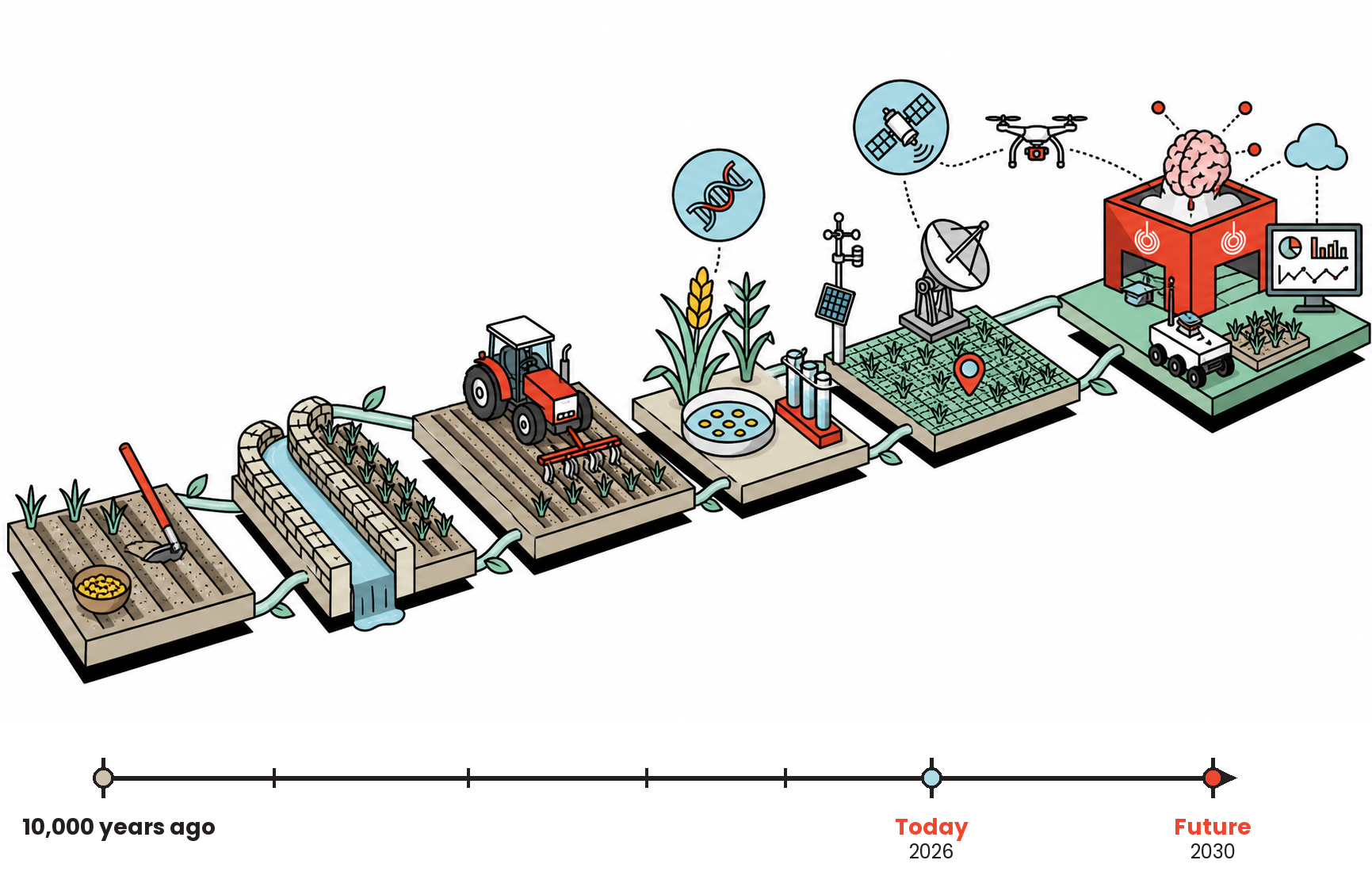
Humanity has been evolving agriculture through innovation for over 10,000 years. AI will power the next wave of innovation.
Agriculture was humanity's first technology: the deliberate working with and influencing natural systems to feed ourselves, beginning around 10,000 years ago. Every leap since; irrigation, mechanisation, the Green Revolution, genomics etc. all extended that same project. AI is the newest tool and the next evolution in the oldest thing we do.
What makes this step different is the nature of the tool. Every major technology wave of recent decades was scaled by finding repetition and banking runs on near-identical transactions. Retail sells the same products through the same channels. Software scales because the underlying reality repeats. Agriculture is the opposite. It runs inside living systems where variability is the baseline: season to season, paddock to paddock, region to region. That is exactly why generic software has always underdelivered in agriculture, rigidly expecting the world and the user to conform to the repetition model.
AI presents the opportunity to go beyond the repetition and into the detail that agriculture has always required. It learns from local data and adapts to conditions that never stop changing. For the first time we have a technology built for variability with the ability to adapt and be customised to specifics of a highly nuanced supply chain.
At Beanstalk, we’ve had the privilege to work across the agrifood ecosystem in the Indo Pacific for the past eight years. When I think about the flow of AI’s capability into the agriculture industry, I think about its potential impact in all parts of the agriculture supply chain, as well as the effect that it will have on the key players in the agriculture innovation ecosystem, from the lab to the field.
Science and R&D
In most industries, R&D is a race against competitors for market share. In crop protection and biosecurity the stakes are much higher. The adversary is evolving biology: resistance, new pathogens, pests moving with the climate. We innovate just to keep pace with nature's rate of change, and for most of history nature has been winning. AI gives me hope that we now have a tool that allows us to move fast enough to counter that. I’m no scientist, but I remember taking specific note when I learned about Google DeepMind’s ‘AlphaFold’ system that predicts the 3D structure a protein folds into from its amino-acid sequence. A protein's shape determines what it does, and figuring out the shapes used to require painstaking lab work (X-ray crystallography) that could take a PhD student years per protein. AlphaFold did it computationally for essentially every known protein, allowing the next generation of scientists to be performing experiments, checking the predictions of AlphaFold, rather than relying on chance to discover protein structures. AlphaFold is already being used to engineer heat-tolerant crops, decode the soil microbiome, and target the gut microbes that drive livestock methane. Problems that previously took twenty years are starting to take months with the power of AI behind them.
Check out:
Profluent: generative AI for protein design; signed a multi-year deal with Corteva in late 2025 to design crop gene-editing systems.
Avalo: "whole-genome AI" that simulates breeding in silico; claims it can halve breeding timelines for complex crops like sugarcane.
Bindwell: AI protein-structure models to discover new pesticide molecules and license the IP directly; teen-founded.
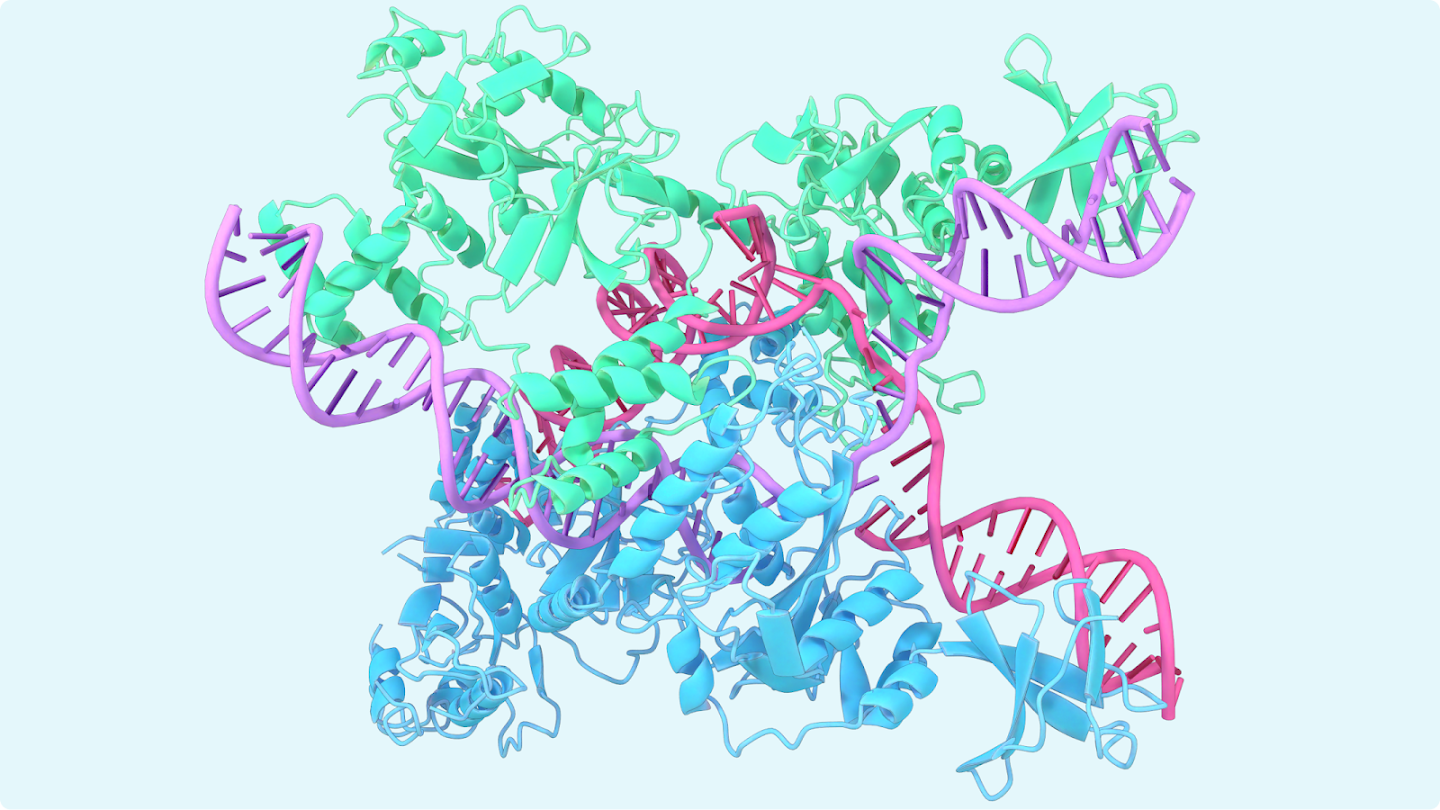
A protein and nucleic acid structure prediction depicted by Google Deep Mind’s AlphaFold AI
Startups
Innovation only reaches farmers and food producers if someone builds it into something that farmers can use, and building for agriculture has historically been brutally expensive. A credible venture needed deep expertise at every layer before it shipped anything. This was true even a year ago when Beanstalk was running our Drought focused Venture Studio, supporting over 80 founders accelerate their path to market, often hugely constrained by execution bandwidth and the combination of broad and deep skill sets needed to take a new company to market. Now a small team can prototype software, run patent searches, shape an IP protection strategy, and build robust user-growth or financial projection models to underpin their strategic assumptions, at a fraction of the old cost. The constraint is shifting from "can you afford to build it" to "is it worth building." For a sector that has always struggled to attract capital and talent, this could present a profound change in the cost and pace of innovation for agriculture and food.
Check out:
Lovable: Turns a plain english idea prompt into a working full-stack web app; lets a non-engineer ship a prototype.
Genie AI: AI drafting and review of the routine legal docs like NDAs, IP assignment agreements, term sheets, shareholder agreements.
Runway: AI-driven financial modelling and forecasting that imports your business numbers to project cash flow and runway, giving founders access to investor-grade models.
Smallholders
AI’s most immediate impact on food production will look different depending on the profile of the production system. For example in South Asia, where we are quite deeply working, (and the majority of the world's farmers live) are the smallholder farmers who need innovation the most and traditionally have not been able to afford it. Good agronomic advice has always required a human expert with local knowledge: scarce, costly, geographically bound. The FAO estimates traditional agronomic advisory costs around $30 per farmer. Digital tools brought this down to $3. AI could bring it to as low as $0.30. A smallholder in northern Vietnam can now access localised, context-aware information to support decisions, in their own language, that adapts to their conditions. Knowledge democratisation and increased access of vital information and decision support empowering smallholders to be more resilient, profitable producers and in-turn, securing their livelihoods.
Check out:
Plantix: image-recognition app that diagnoses crop pests, diseases and nutrient deficiencies from a smartphone photo and returns instant management advice.
Intello Labs: AI powered computer-vision grading of produce by quality, colour and size, linking farmers directly to buyers to improve price realisation and cut market opacity.
Enfarm: Precision nutrition and price intelligence AI and IoT soil-nutrient sensors that give farmers real-time crop-nutrition guidance, plus yield forecasts and market price updates.

Plantix in use in India.
Agribusiness
For years at Beanstalk we have watched corporate agribusinesses hunt for the one perfect platform that does everything. They always reach the same conclusion: it doesn't exist. You pick the best tool for each job, and then those tools don't talk to each other, and they never flex across the business, from field staff to farm managers to portfolio managers to head office to the board. The real value was always locked behind an integration that nobody could justify building. Razor thin margins in agribusiness meant these businesses could never warrant the specialist roles other industries take for granted.
Now, agentic workflows can take us from just having better ways to interact with our data, to building an intelligence layer that becomes the operating system that businesses run on. The analysis, reporting and decision support, that once needed headcount these businesses couldn't afford, is suddenly viable. This is important at a time where every input costs is trending in the wrong direction, making any margin re-capture mission critical.
For this sector in the agriculture value chain, a neat set of example AI tools wouldn't illustrate the point I'm trying to make.
Instead, let me share this insight: the leading agribusinesses we are speaking to are not talking about how to be 10% more efficient at head office, but are thinking about how AI can fundamentally change how they run their operations, increase margins, and reduce risk. We are already seeing first mover agribusinesses enjoying the benefits of building agents that can take action, based on a rich layer of curated enterprise context, and in turn free their employees to do higher value and often more stimulating work.
This represents a step shift in how the agribusinesses of the future are rewiring themselves to embed AI capability across their entire operation, all the way from the field, through to their end customers.
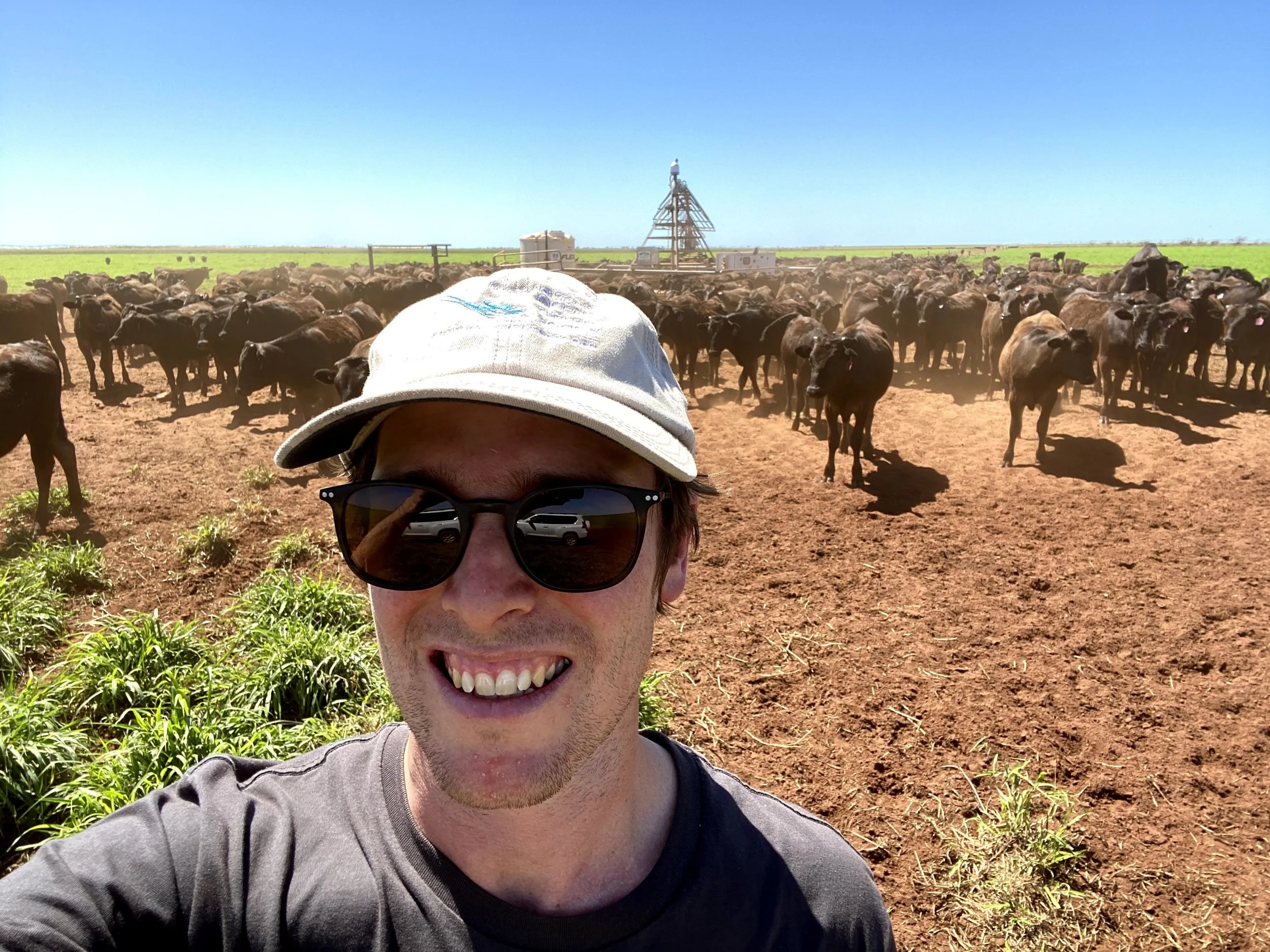
Cal Archibald visiting a cattle station in WA to build a digital integration dashboard. AI powered tools are the next evolution of this work.
So where to from here?
For the first time in agriculture's 10,000-year history of innovation, the bottleneck constraints are reducing and changing. The science is accelerating. The tools are becoming more affordable. The intelligence and execution bandwidth that only the biggest, best-resourced businesses in the world could access last decade is now within reach of a startup in Singapore, a grain grower in Western Australia, and a smallholder in the Mekong Delta.
This is a genuinely historic shift, and we just so happen to be right at the beginning of it. For me this is an absolute chance of a lifetime to work with all of the key players across the agrifood ecosystem, from R&D labs, to governments, to the world's largest agribusinesses, to leading startup companies; as they experiment and figure out what this shift means for them.
But, here is the kicker: access to a tool has never been enough.
The example that comes to mind is the Green Revolution. It gave us new seed varieties, but the question was always whether farmers could access them, trust them, and use them in conditions no textbook had anticipated. AI is no different. The binding constraint now is adoption, and adoption in agriculture is uniquely hard, spread across millions of operators, in wildly different conditions, running on margins that punish mistakes.
We are at a critical moment in the most important agricultural challenge of our generation. The gap between what is possible and what is actually embedded in the way food is grown, traded and managed is the fun (read: hard) part. The food system finally has the tools to meet the demands we are placing on it. The question is whether we can move fast enough, together, to make it count. This space is moving so quickly that neither Beanstalk nor anybody else has the answer to exactly how this is going to play out.
My personal take: at a time where the agrifood industry is asking "what can AI do for me," we should also be asking “what can we do to maximise the benefits of AI across the ecosystem," and in doing so, ensure that the power of AI can be applied to nudging the food system transition in the right direction. That question is the topic of great debate currently within Beanstalk, and I think it is the most important question in agriculture right now.
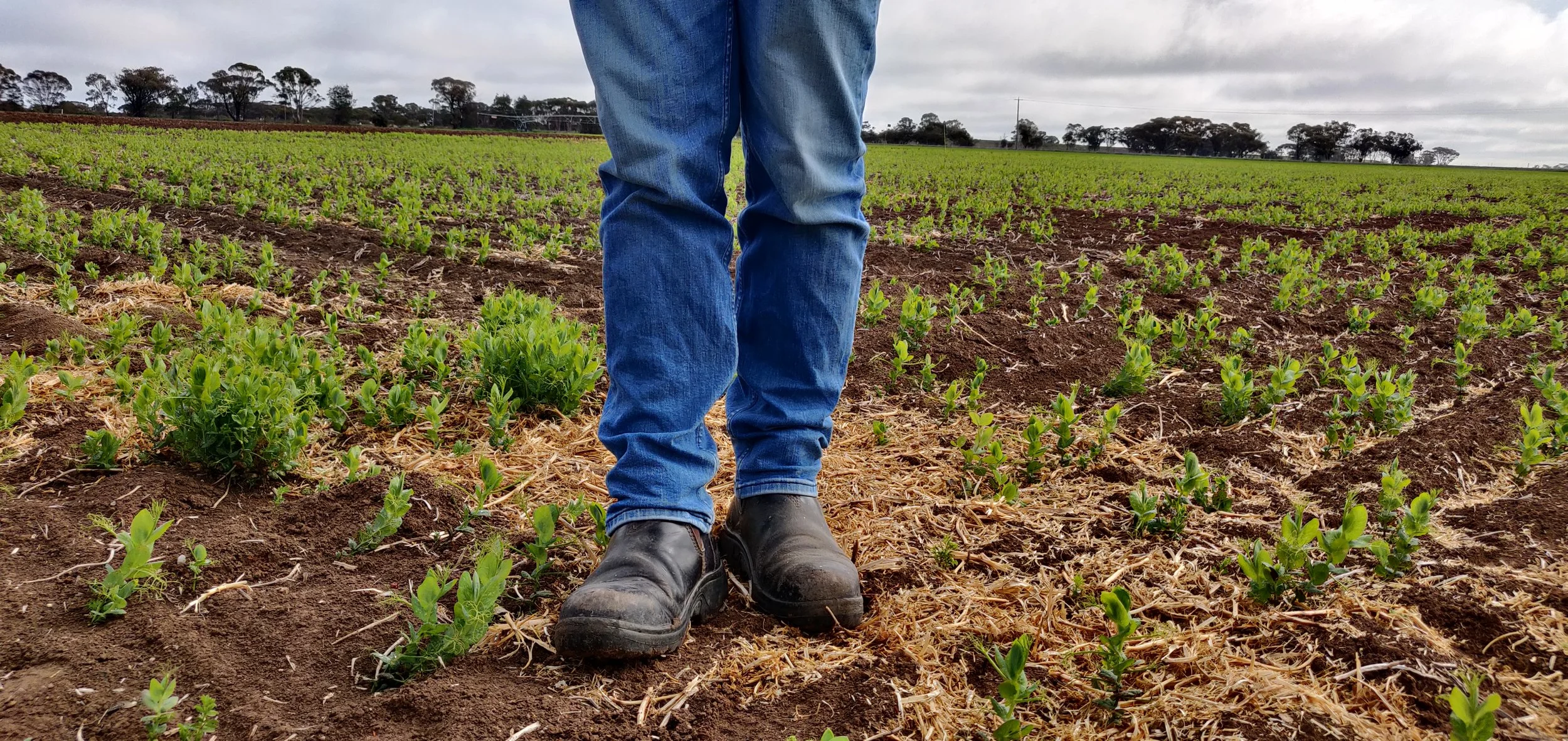
A test field for new legume cultivars at Grains Innovation Park in Horsham, Victoria. AI powered tools could significantly transform their crop research timelines.