
We deployed AI across our workflow. Here is what we have learned so far.
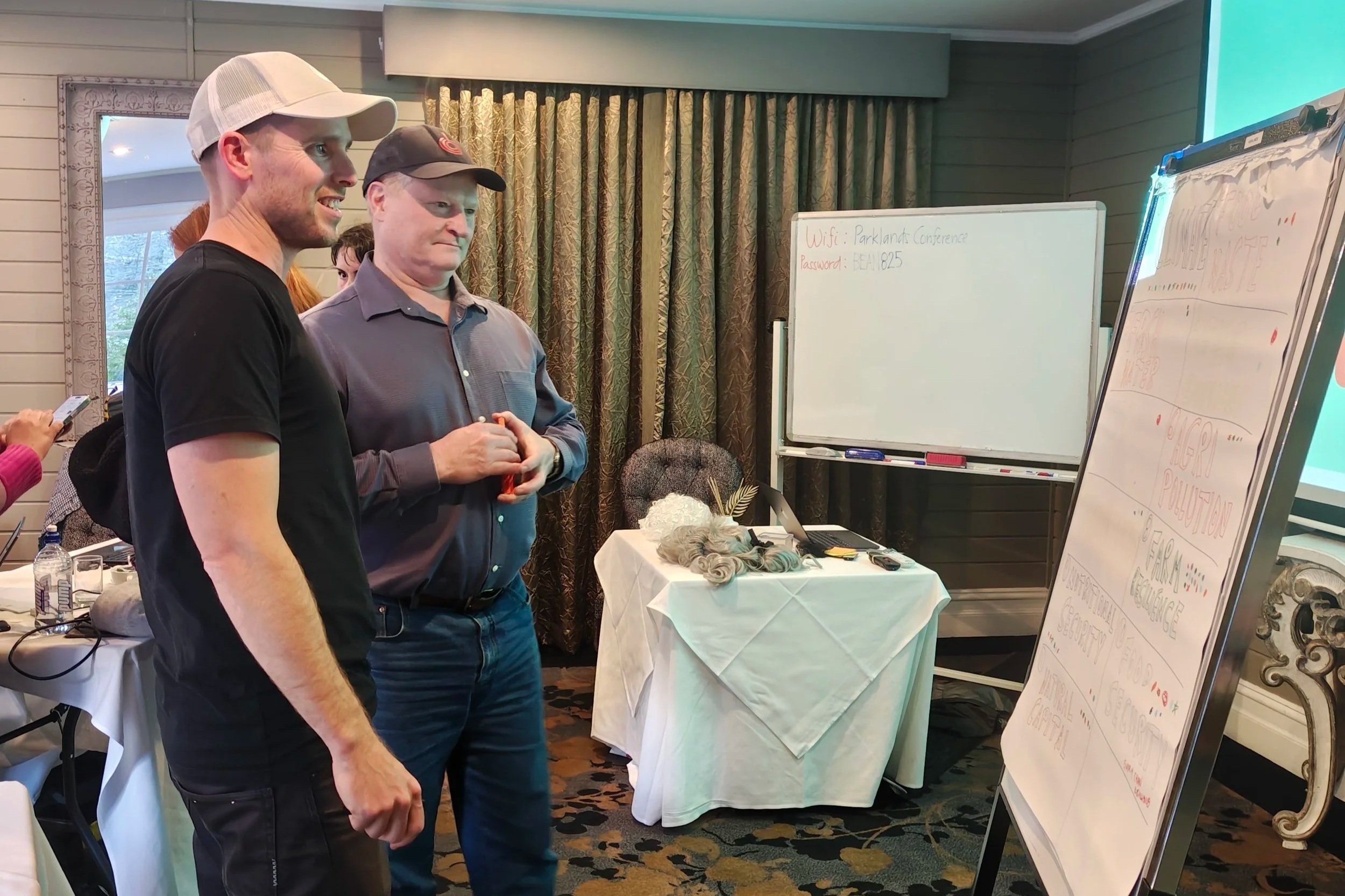
Cal Archibald at a recent Beanstalk strategy day
A few months ago we rolled out Anthropic's Claude AI to the whole Beanstalk team. It has been a wild learning journey; and exciting for a team that spends its time advising other organisations on innovation strategy, to be in the hot seat innovating ourselves.
Over the first few months, the spread in adoption across the team was emerging. At Beanstalk we spend all day, every day thinking about innovation, technology adoption, bridging gaps and how organisations change. I assumed that made us different when it came to rolling out new technology tools within our own business. It didn't. Some people were immediately all in, while others had logged in a handful of times.
What surprised me most was that we, Beanstalk, weren't immune to this gap. Within weeks we had exactly the same distribution you'd find in any agribusiness we work with: a small group of early movers building things we hadn't imagined, a larger middle group using the tools consistently and usefully, and a group of people who were just as curious as the rest, but needed more support to upskill and translate that into real action. Same access, same encouragement, completely different outcomes.
One thing that the most active group of AI users in the business all agree on is that it's probably not yet a net time-saver in every application, we are seeing huge time savings in individual workflows, but there has been a substantial investment of time to get there, based on an expectation of future efficiency as well as investing in learning and understanding how all the plumbing works as a future enabler.
So we asked ourselves: what does it actually take to bring a team along on an AI journey, not just expose them to it?
Here's what we're doing and why.
Why we got started
We began with a professional curiosity trying to understand what AI actually means for the agrifood industry broadly. The potential is hard to ignore. AI democratises access to knowledge and resource-intensive capabilities that have historically been out of reach for most farming operators and early-stage ventures. It changes what's possible for a startup with a small team, or a family business trying to run leaner and meaner, and has the potential to be one of the biggest forces multiplying our mission to grow enough food to feed a growing population in a way that is profitable for producers and sustainable for the planet. As we dug into what this meant for the sector, we realised fairly quickly that we were researching ourselves as well. Then the real trigger point came with the release of Claude Cowork in February 2026 and the potential and the reality of these tools got real very quickly! Immediately we recognised, if we were going to help agribusiness leaders navigate this amazing tool, we needed to not just be keeping up with it, we need to be living it out on the leading edge.
Informing our decision
Before we rolled out anything, we took our own advice and did the work to figure out the known low hanging use cases, the right tools, the ROI. Team members Linley Houwen, Yiwen Lu and Lily Tao led an internal structured process late last year: surveying the team to understand where the real friction and opportunity sat across our workflow, researching the landscape of tools, and pressure-testing where AI could genuinely move the needle for a business like ours versus where it was just noise. Claude wasn't the default choice, it was the considered one. At the time I remember it feeling like we were moving too slowly, but I can now say the groundwork has already paid dividends. It meant that when we rolled out the tool, we weren't guessing at use cases, we already had a clear picture of where value was most likely to land and a view of how Claude was the right tool for some use cases and realistic about the limitations of others.
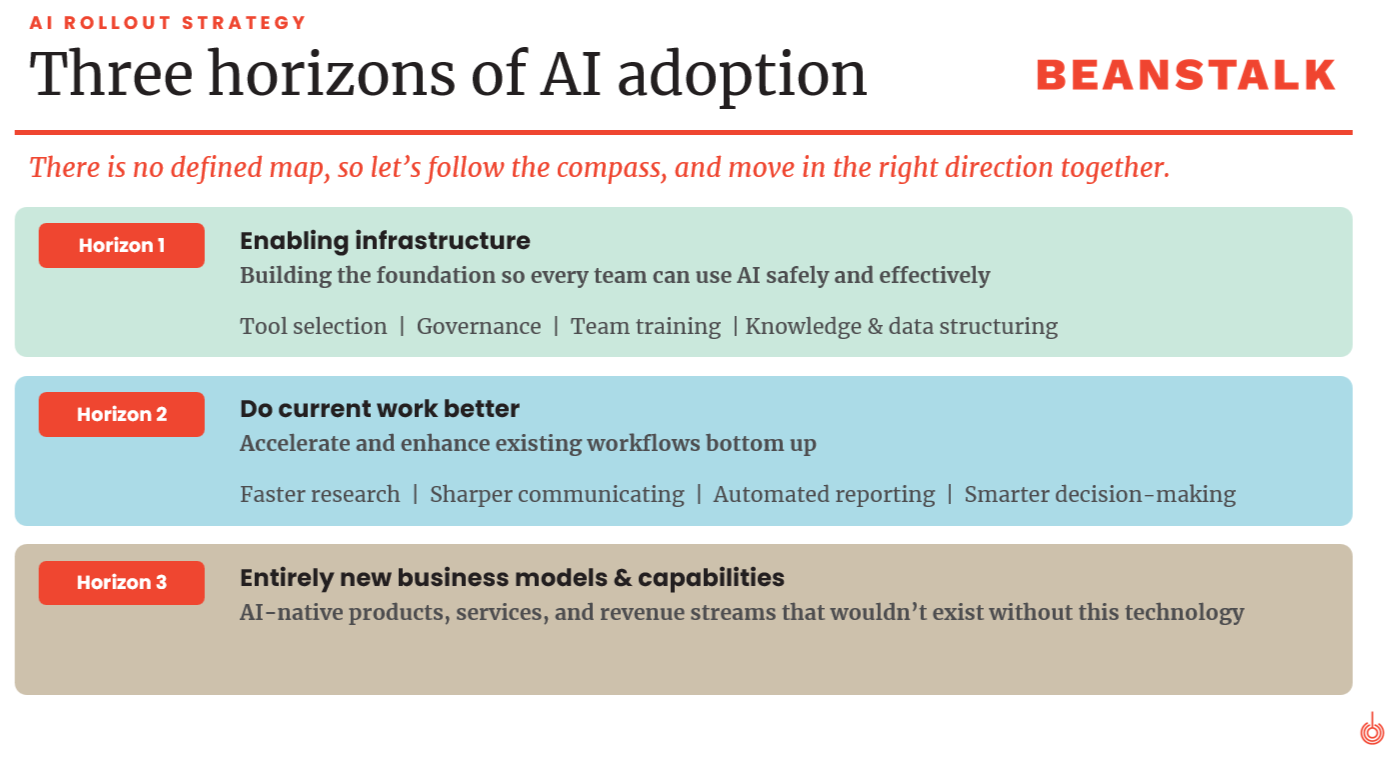
Beanstalk’s simplified AI strategy on a page
A foundational shared direction
Next, we shared a Three Horizons AI adoption strategy with the team. We were upfront that we don't have everything figured out. With the pace that AI is moving and evolving, no one does. We don't know exactly where this goes. But we have a shared our vision for understanding of how we're going to work toward it together as a business. Without that foundation, every tool, every experiment, every "wow have you tried this" and every “I just wasted an hour and all my tokens” moment floats in a vacuum. Our AI strategy gave everything else a place to land. For those contemplating the same process, I'd be glad to share more about our Three Horizons framework, but here is a snapshot of what we shared with the Beanstalk team.
An AI Champions group
We pulled together a small group representing different parts of the business. Not the most technical people, but a cross section across our business operations (think finance, operations, marketing) and service lines (think landing pads, venture studios and advisory). Their job is to be our internal cheer squad and encourage everyone around them, but also to manage and triage the pipeline of internal tools and skills we're building. Nothing gets released to the broader team until it's genuinely ready. We want to encourage everyone in the team to be a builder, but quality control matters when you're asking people to trust new ways of working.
Weekly AI sessions
We knew we would need regular and consistent sessions to help our entire team upskill and embrace this technology. What started as a structured Q&A has evolved into something more useful: a weekly show and tell. Team members do a screen share and demo things they've built, walk through a new feature the rest of the team should know about, or do a live one-on-one about something they've been working through. Low pressure, high value. It normalises the conversation and makes sure nobody is figuring this out alone. Importantly, we are recording all our AI learning sessions, so that the team can return to them in their own time if they need.
A pulse check survey
We're doing our best to measuring how we are going. The survey ran across three sections:
The Baseline: to track adoption and usage over time, this will be done quarterly
The Vibes: a read on how the team is actually feeling about AI in their workflow including confidence and where the support gaps are
The Learnings: and finally a knowledge harvest. What are the best resources people have found? What's one thing you wish everyone else on the team understood that would make your life easier?
That last question alone surfaced more useful insight than a dozen team meetings could have!
An internal hackathon
We kept hearing the same thing: people were experimenting with AI, starting to build things, but a busy workday kept getting in the way of finishing. Good intentions, but a lack of final polished outputs, which is where the leverage comes from. This Friday we will be hosting our first internal hackathon. It’s about defending the time within the team to make sure no one gets left behind. A dedicated block to troubleshoot, finish what's been started, and co-mentor, brainstorm and build together. Hands-on practice produces far better skill transfer than any training session ever will.
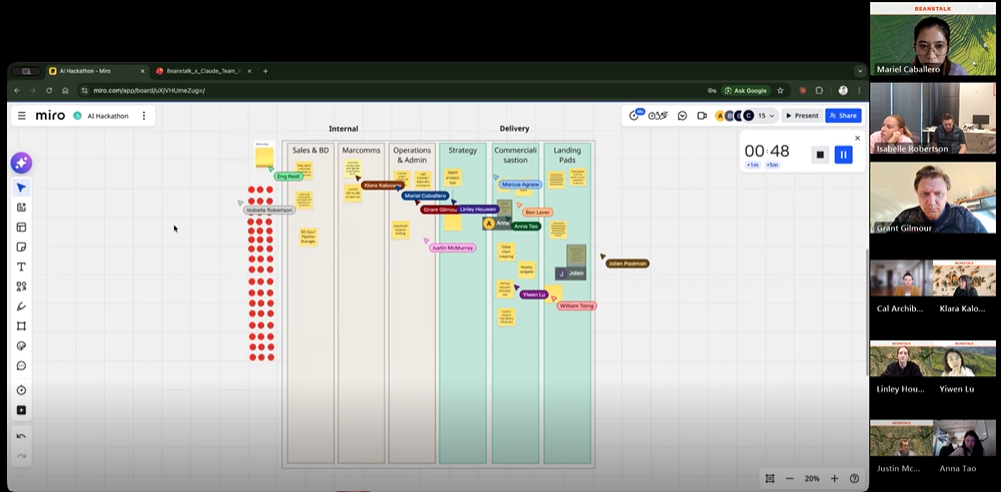
The Beanstalk team voting on the AI tools and skills they would like to build in the upcoming AI Hackathon
Our AI transition is ongoing, and we have a feeling its going to be ongoing for a while… in a good way! We're learning that the businesses that get AI (or any major technology transition) right are the ones who do the foundational work around AI strategy that makes the AI tools worth investing in. At the moment we're pretty focused on what may seem like the ‘boring’ foundational stuff in Horizon One, but if we know if we get that right and invest the time in bringing the team along for the journey, then it'll be a huge unlock for Horizon Two and ultimately Horizon Three where we get to completely reimagine how we deliver value and accelerate our impact towards our mission.
We are sharing and learning as we go, so if you have thoughts on how you are doing things differently than we'd love to hear them. We might even get together a few of our internal AI champions and host a lunch and learn session! If that's interest, please let me know and reach out directly.